Even With High Gas Prices, It's Still Not Cheaper To Drive An EV
High prices at the pump usually offer the strongest argument for going electric. Yet, according to AAA's 2026 Your Driving Costs study, electric vehicles still carry a slightly higher total ownership cost than their internal combustion and hybrid counterparts.
The primary culprit isn't energy cost—where EVs dominate—but rapid depreciation and higher financing fees that eat away at those savings over time.
The study, which calculates five-year ownership costs across 75,000 miles, pegged the average cost of operating a new vehicle in the U.S. at $12,863 annually. Despite the overall cost premium, a 32 percent surge in national gasoline prices—averaging $4.15 per gallon in the study—brought EVs to near financial parity with gas and hybrid models in three out of four vehicle segments analyzed.
Lower Fuel Costs Met by Steeper Depreciation
The math behind operating an EV highlights a dramatic trade-off between the charging plug and the resale value.
EV owners saved roughly 70 percent on fuel compared to traditional gas vehicles, spending an average of just $771 annually on electricity for a compact crossover versus $2,382 for gas and $1,731 for a hybrid. Electricity prices rose a modest 7.8 percent to 18 cents per kilowatt-hour over the same period.
However, depreciation wiped out those fuel savings. In the compact crossover category, depreciation accounted for $5,298 per year for an EV, compared to $3,568 for a gas vehicle and $3,845 for a hybrid.
Compact SUV Annual Operating Costs Breakdown:
- Electric Vehicle: $11,888 total ($0.79/mile) | $5,298 Depreciation | $771 Fuel
- Gasoline Vehicle: $11,656 total ($0.78/mile) | $3,568 Depreciation | $2,382 Fuel
- Hybrid Vehicle: $11,201 total ($0.75/mile) | $3,845 Depreciation | $1,731 Fuel
The depreciation gap was largely exacerbated by last year's repeal of the federal $7,500 EV tax credit, which artificially inflated original sticker prices and triggered sharper secondary-market value drops. Industry analysts expect that gap to stabilize as used EV supply and demand align.
Hybrids Take the Overall Ownership Win
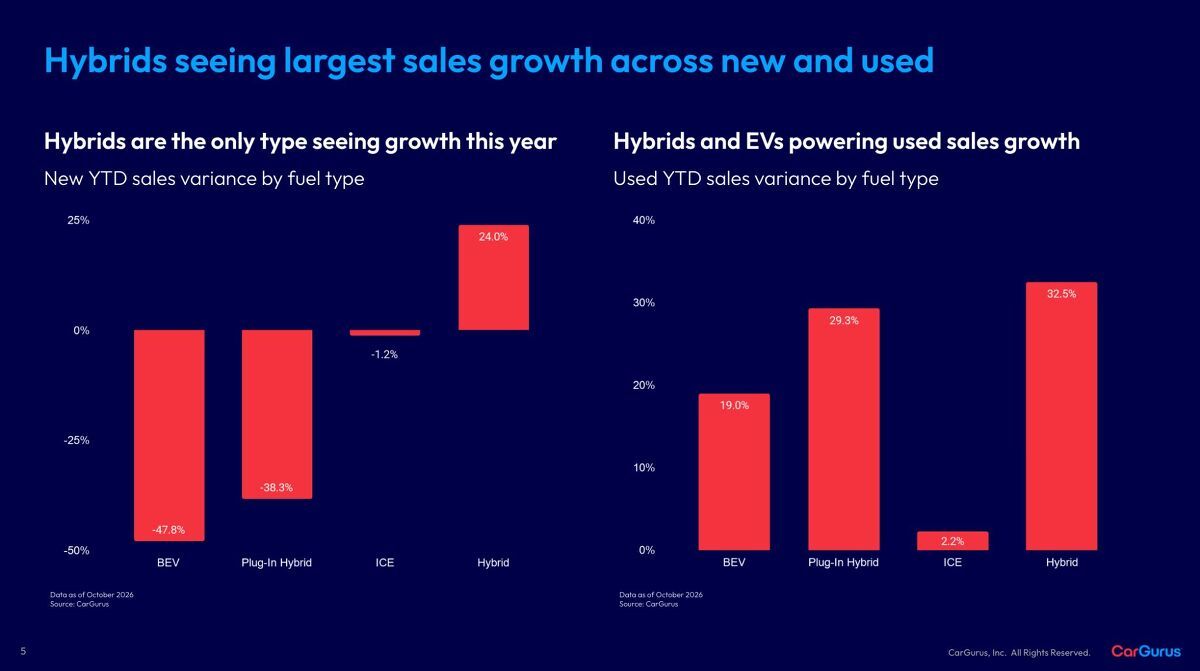
While EVs closed the gap in compact crossovers, midsize crossovers, and full-size pickups, they struggled in the midsize sedan segment—where heavy EV depreciation pushed total ownership costs 29.1 percent higher than gas equivalents.
Across all four segments, hybrid vehicles emerged as the clear value champion. Hybrids combined meaningful fuel savings with mild depreciation and lower finance charges. Maintenance costs also favored hybrids over gas vehicles, while remaining surprisingly close to EVs. In the compact SUV class, annual maintenance ran $1,402 for EVs, $1,506 for hybrids, and $1,954 for traditional gas models. In full-size pickups, electric truck service costs ($1,618) actually ran higher than hybrid service costs ($1,539).
Insurance rates also showed signs of normalization. While covering an EV compact crossover previously carried a $300 annual premium over a gas car, this year's study showed EV insurance ($2,277) virtually on par with gas models and slightly cheaper than hybrids.
With fuel prices remaining elevated and vehicle transaction prices averaging $39,376, AAA engineers note that individual driving habits, local charging rates, and loan terms can easily flip the math in favor of any powertrain.
This article was written using AI and was then edited and optimized by our editorial team.