Someone Just Paid $460,000 for a BMW M5 and it's Definitely Worth it
Key points
- The Secret Testbed: Why a BMW M5?
- Engineering & Key Specifications
- Why the $460,000 Price Tag is Justified
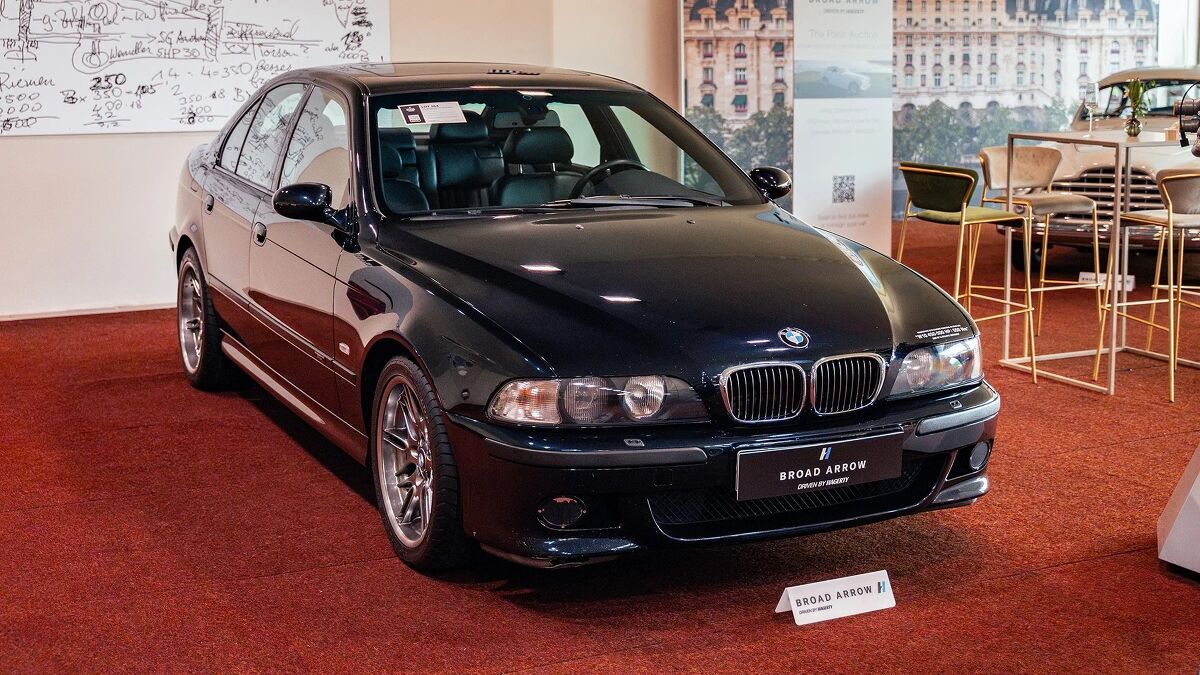
At Broad Arrow’s Zoute Concours Sale in Knokke-Heist, Belgium, an unassuming 2000 E39 BMW M5 finished in Carbon Black Metallic crossed the block. To an untrained eye, it looked like a clean, well-preserved executive sports sedan. But as intense international bidding erupted, the hammer finally fell at €411,250($460,000 USD), setting a world record for any E39 BMW and becoming the most valuable non-charity M5 ever sold at auction.
Why would anyone pay nearly half a million dollars for what appears to be a standard E39 M5? Because under its factory bonnet sits one of automotive history’s most audacious secret projects: a experimental Volkswagen W10 engine engineered on the orders of Dr. Ferdinand Piëch.
The Secret Testbed: Why a BMW M5?
In 1999, Volkswagen Group CEO Dr. Ferdinand Piëch was determined to push the boundaries of engine packaging and output. His engineers were developing a novel, compact narrow-angle W-engine architecture created by mating two VR5 cylinder banks onto a single crankshaft. This W10 design was envisioned as an intermediate step to test the multi-bank engineering concepts that would eventually blossom into the 1,001-hp quad-turbo W16 powering the Bugatti Veyron.
At the time, Volkswagen and Audi lacked a suitable rear-wheel-drive sedan platform with a engine bay configured to handle a high-torque manual drivetrain. Volkswagen’s solution was as pragmatic as it was discreet: buy the undisputed benchmark performance sedan of the era (a brand-new E39 BMW M5) yank out its factory 4.9-liter S62 V8, and custom-install the experimental W10 powertrain.
To keep the project hidden from competitors and media alike, Dr. Piëch used the discreet BMW as his personal daily driver during development, commuting on temporary test plates.
Engineering & Key Specifications
While the exterior looks completely stock (even retaining the factory car phone in the center armrest) the mechanicals underneath are pure prototype race-craft.
Under the hood, the car is powered by an all-aluminum, 5.0-liter naturally aspirated W10 engine that produces between 473 and 480 horsepower along with 437 lb-ft of torque, giving it roughly an 80-horsepower bump over the stock S62 V8. That power is delivered to the rear wheels through a factory six-speed manual transmission.
Only three W10 engines were ever produced by Volkswagen. One resides in Germany, while the second was installed directly in this prototype. The winning bidder at the Broad Arrow sale actually secured two of the three engines in existence, as the auction lot included the standalone spare display engine alongside the car itself.
Why the $460,000 Price Tag is Justified
In collector car markets, ultimate value is driven by provenance, rarity, and historical impact. This car delivers all three at an unprecedented level:
- The Missing Chapter of the Bugatti Veyron: Without this exact running prototype, the packaging and firing-order engineering required for the Bugatti W16 engine family may not have evolved as quickly. It represents the physical bridge between VW’s humble VR engines and hypercar supremacy.
- Unrepeatable Rarity: It is the only road car in the world fitted with a Volkswagen W10 engine.
- Piëch Ownership Factor: Dr. Ferdinand Piëch is widely regarded as one of the greatest automotive executives in history. Owning his personal, off-the-books test mule is the holy grail for collectors of VW Group and Porsche family history.
While $460,000 is an extraordinary price for an E39 chassis, the buyer didn't just purchase a BMW; they bought a one-of-a-kind piece of engineering history that redefined modern performance motoring.